

Many salaried employees in California are entitled to overtime pay. Simply receiving a salary in California does not automatically exempt employees from earning overtime pay. Exemption depends on satisfying both a salary test and a duties test, not simply one or the other. Most salaried employees who fail to meet both tests are still entitled to overtime under the same rules that apply to hourly workers.
My Job Lawyer has represented California employees in wage and hour disputes for more than 25 years, recovering more than $10 million for workers across 500 or more cases. Our wage and hour attorneys review the job duties, pay structure, and record of working hours to check if an exemption to salary applies. If your boss says you’re exempt, you can schedule a consultation to find out whether that applies.
This article explains the salary basis test, the duties test, how California overtime rules apply to nonexempt salaried employees, whether overtime pay can be waived, and what happens when an employer misclassifies a worker as exempt.
Does Being Paid a Salary Mean You Are Exempt From Overtime?
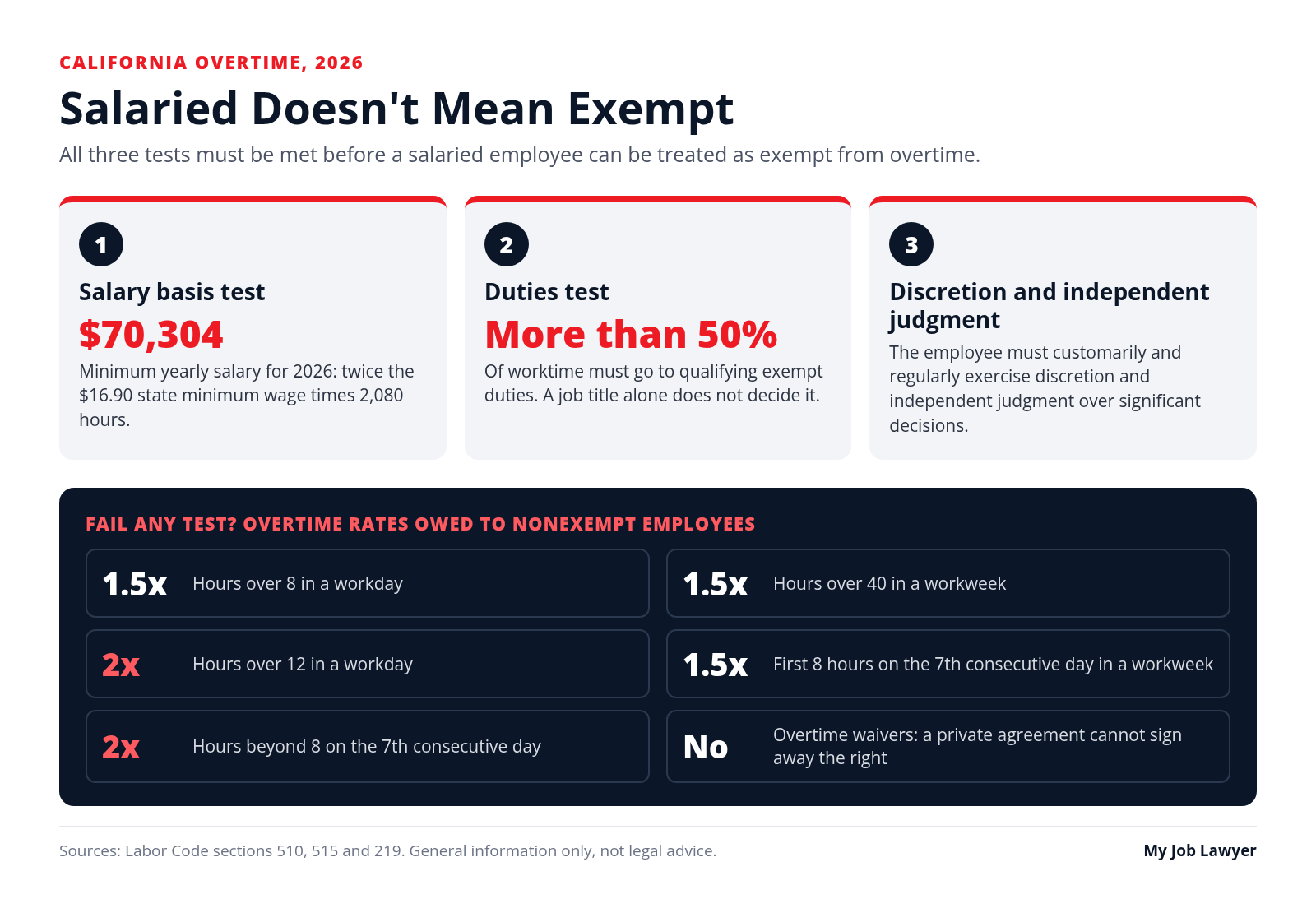
No. A paycheck labeled salary says nothing on its own about whether an employee is exempt from California overtime laws. The Industrial Welfare Commission is authorized under Labor Code section 515 to exempt certain employers’ executive, administrative, and professional employees, but only when three separate requirements are met together, not as alternatives. Employment lawyers refer to these as the salary basis test, the duties test, and the discretion and independent judgment test, and all three must be satisfied before an employer can treat a salaried worker as exempt from overtime. A job title alone does not affect exempt status, and neither does a company policy that simply declares a position salaried.
These categories serve a narrow purpose under California overtime laws, intended for employees who actually exercise meaningful managerial or professional judgment, not every employee paid a fixed amount each pay period. Specific rules laid out in Wage Order regulations define precisely what job duties and responsibilities count toward qualifying. Salaried employees who do not clear every part of the test remain nonexempt employees, entitled to the same overtime protections as hourly staff.
What Is the Salary Basis Test for Exempt Status in 2026

The salary basis test sets a minimum amount an employer must pay before an employee can even be considered for exempt status, regardless of the job duties involved. Under Labor Code section 515(a) and (c), the minimum monthly salary for exempt status equals twice the state minimum wage for full-time employment, defined as 40 hours a week. For 2026, California’s Department of Industrial Relations set the state minimum wage at $16.90 an hour, based on DIR’s own published 2026 minimum wage rate. Multiplying that figure by the statutory formula, two times $16.90 times 2,080 hours a year, produces an exempt salary threshold of $70,304 for 2026.
This number is not a rigid rule that stays the same from year to year. California’s minimum wage rates adjust annually under a cost-of-living formula, so the exempt salary threshold moves with it, and $70,304 applies specifically to 2026. Many of the same salary figures also appear in the Industrial Welfare Commission wage orders, published in the California Code of Regulations, which restate the identical formula for specific industries. In 2026, an employee making less than $70,304 a year, even though they look like managers, should not be considered exempt solely based on salary basis tests.
What Is the Duties Test for Exempt Status
The duties test asks what an employee actually does at work, not what the job title says. Labor Code section 515(e) defines the standard directly, stating that “primarily” means “more than one-half of the employee’s worktime.” That is a strict numerical threshold, not a vague impression, and it is noticeably stricter than the federal standard under the Fair Labor Standards Act, which asks only what an employee’s primary duty is without requiring a specific percentage of time.
California deliberately adopted this stricter approach numerically. The California Supreme Court held in Ramirez v. Yosemite Water Co. that the state’s duties test rejects the more flexible federal balancing approach in favor of the specific, more than half rule set out in the statute. Executive, administrative, and professional exemptions each carry their own qualifying duties, and the regulations also require that an exempt employee customarily and regularly exercise discretion and independent judgment over significant decisions, not just the title of manager.
Steven Nassi has looked at this pattern many times. “A title like manager does not end the analysis,” Nassi says. “We look at what the employee spends most of the actual workday doing and whether that work meets the legal definition of exempt duties before we ever accept an employer’s label.”
For example, a retail employee called an assistant manager who spends most shifts ringing up customers and stocking shelves, with only occasional supervisory authority, likely fails the duties test even if paid well above the salary threshold. Many managers who carry the title without matching day-to-day duties remain nonexempt employees, entitled to overtime like everyone else. Employees unsure where they fall often benefit from legal counsel reviewing their actual job duties against the statutory test.
How California Overtime Rules Work for Nonexempt Employees

Nonexempt employees, whether paid hourly, by salary, or by piece rate, are entitled to overtime under California overtime laws whenever they work beyond certain daily or weekly limits. Labor Code section 510 specifies different rate levels rather than having one rule, and the table below lists each level along with the corresponding rate.
California pairs a daily trigger with the weekly trigger, so an employee working eight hours a day for six days, 48 hours total, earns overtime on the extra hours even though no single day passed 12 hours. On a seventh consecutive day worked within the same workweek, the law splits the day in two: the first eight hours pay at 1.5 times the regular pay rate, and any hours beyond eight that same day pay at double time.
This structure applies across industries, from office work to retail to the construction industry, regardless of where in California an employer is located. A handful of employers use an alternative workweek schedule adopted under a separate exception that changes when the daily trigger starts. Working time counts toward both limits, beginning at the start of each regularly recurring fixed work week.
For salaried nonexempt employees, Labor Code section 515(d) requires converting the weekly salary into an hourly wage equivalent, found by dividing the salary by 40, and that rate applies to every overtime hour worked, regardless of what forms of pay a business uses elsewhere, including piece rate pay. An explicit agreement to pay a flat salary covering all hours will not override this calculation, and any work that goes over the legal limits must be paid at higher rates.
Can You Waive Your Right to Overtime Pay?
No. California treats the right to overtime pay as a public protection meant to protect a broader interest, not a private benefit that an employee and employer can bargain away. Civil Code section 3513 states that a law established for a public reason cannot be contravened by a private agreement, and Labor Code section 219 applies that same rule specifically to wage payment statutes like section 510 and section 515. Neither party can sign away the overtime requirement in advance, whether the agreement is written, verbal, or simply assumed from how the job was offered.
There is a very limited exception to this rule. Once overtime wages have already accrued, an employee and employer can sometimes resolve wage claims over those specific unpaid amounts through a negotiated settlement, typically with a formal release and real consideration exchanged. That differs from a prospective agreement to work for straight time only, which remains unenforceable no matter how it is phrased. Labor Code section 1194 lets an employee recover unpaid overtime plus interest, and that statutory right survives even a signed offer letter calling the position overtime exempt as a condition of hire.
What Happens if Your Employer Misclassified You?

Employers must compensate nonexempt employees for every overtime hour actually worked, and those who misclassify a nonexempt employee as exempt can become liable for more than just the unpaid overtime itself. If the misclassification affected a terminated employee’s final paycheck, Labor Code section 203 adds waiting time penalties continuing at the employee’s daily wage rate for up to 30 days after termination. Labor Code section 226 adds separate wage statement penalties, $50 for an initial violation and $100 per employee for each later violation in a subsequent pay period, capped at an aggregate of $4,000, since misclassified overtime rarely shows up correctly on a pay stub. Some misclassification cases, particularly ones also involving minimum wage shortfalls, can carry liquidated damages on top of the lost wages themselves.
California Labor Code sections covering these penalties work alongside the Private Attorneys General Act, which lets an employee pursue civil penalties for a pattern of violations across a business, not just individual claims. California employers should treat a misclassification review as a real compliance risk, since the Labor Commissioner’s Office can open an investigation after a single complaint. An employee who suspects they have been misclassified should be aware that retaliation for reporting this is illegal too and should ask for their payroll records so a lawyer can check if there’s a valid claim.
If you believe your employer misclassified you, documenting your actual job duties, shift length, and any employee benefits tied to your role strengthens a wage claim. Many employees also review related issues such as whether they can sue an employer for not paying them or what an average settlement for unpaid wages might look like, though every case depends on its facts.
Ready to Talk to an Employment Attorney About Overtime Pay?
Salaries alone never answer the issue of overtime pay in California. Determining exempt status requires looking closely at the salary basis test, the duties test, and the discretion and independent judgment test together, not picking whichever one is convenient. Employees paid a fixed amount every pay period deserve a clear answer about whether that pay covers all of their hours.
Steven Nassi has represented California employees in wage and hour disputes for more than 25 years, recovering more than $10 million for workers across 500 or more cases, and has been named a Super Lawyers Rising Star. Our wage and hour attorneys review pay records, job duties, and hours worked to check if a position qualifies for an actual exemption. Contact us today to go over the facts of your situation with an attorney.
Frequently Asked Questions
Steven Nassi and the My Job Lawyer team receive frequent detailed questions from salaried workers who wonder if they are exempt from having to be paid overtime. These answers serve as a general reference reflecting current California law, not advice about any specific job or paycheck.
What Is the Minimum Salary a California Employee Must Earn in 2026 to Be Classified as Exempt?
For 2026, a California employee must earn at least $70,304 a year to meet the salary basis test, based on twice the $16.90 state minimum wage times 2,080 hours a year under Labor Code section 515.
Does Being Paid a Salary Automatically Mean I Am Not Entitled to Overtime?
No. A salaried employee who does not pass both the duty test and the test regarding discretion and independent judgment is still entitled to overtime pay for hours worked over the threshold for daily and weekly limits.
What Is the Difference Between an Exempt and Nonexempt Employee?
An exempt employee meets all three criteria from Labor Code section 515 and therefore does not get paid for overtime work. A nonexempt employee, salaried or hourly, is entitled to overtime for hours worked beyond eight in a day or 40 in a week.
How Does California Overtime Law Differ From Federal Law?
California applies a daily eight-hour overtime trigger in addition to the 40-hour weekly trigger, and its duties test uses a stricter than half of worktime standard rather than the federal government’s more flexible primary duty standard. This rule applies to work done in California no matter where the company is headquartered.
What Is the Duties Test and How Much of My Time Must Be Spent on Exempt Work?
The duties test under Labor Code section 515(e) requires that an employee spend more than one half of their worktime on qualifying exempt duties, not simply some portion of the day.
Can My Employer Require Me to Work Over 8 Hours a Day Without Overtime if I Am Salaried?
If you are nonexempt, no. Your boss can ask you to work a longer shift during a day, but any time you work beyond 8 hours on that same day has to be paid at overtime rates based on your regular pay rate.
How Is Overtime Calculated if I Work a 7th Consecutive Day in the Same Workweek?
The first eight hours worked on a seventh consecutive day in the same workweek pay at 1.5 times the regular pay rate, and any hours beyond eight that same day pay at double time.
Can I Agree to Waive My Right to Overtime Pay?
No. Civil Code section 3513 and Labor Code section 219 prevent a private agreement from overriding the statutory right to overtime, though a settlement of wages already owed is handled differently.
What Penalties Can an Employer Face for Misclassifying Employees as Exempt?
An employer can face liability for unpaid overtime, waiting time penalties under Labor Code section 203, wage statement penalties under Labor Code section 226, and potential claims under the Private Attorneys General Act.
Does the Exempt Salary Threshold Change Every Year
Yes. Because the threshold is based on California’s minimum wage, which goes up yearly, the amount that exempts people from overtime pay changes each year too, and $70,304 applies specifically for 2026.
This article provides general information on California laws regarding exemption and classification of salaries and overtime work. Please note that this article is informational and does not offer legal advice or guarantee any outcome. The statutes referenced reflect California law as of this writing and may change from year to year, particularly the exempt salary threshold, so anyone questioning their own exempt status should consult a licensed California employment attorney.