

Yes, you can sue your employer for not paying you if their decision not to pay is in violation of federal or your state’s wage laws. These willful violations may include not paying minimum wages, illegal deductions, or misclassifying you as a contractor to avoid paying overtime. When an employer withholds wages, underpays, or makes unlawful deductions, these actions may constitute wage theft and provide grounds for a legal claim.
At My Job Lawyer, we have spent over 25+ years in service of clients with employement law cases. In that time, we have recovered more than $10 million for workers across 500+ cases. Our team includes California-licensed attorneys like Steven Nassi, who was named a Super Lawyers’ in New York Metro Rising Stars list from 2014 to 2018. If you were wrongfully terminated or your employer won’t pay what you’re owed, contact us for a free case review to understand your options.
This article breaks down how employees can take legal action to recover unpaid wages, file a claim, and hold employers accountable under wage and hour laws.
What Are My Legal Rights If My Employer Is Not Paying Me?
Did your paycheck come up short, or didn’t show up at all? You’re probably wondering what to do next. The good news is you don’t have to just accept it and move on. If your employer isn’t paying you, they’re in the wrong. Federal and state laws protect your right to receive every dollar you’ve earned, including regular wages, overtime, and benefits.

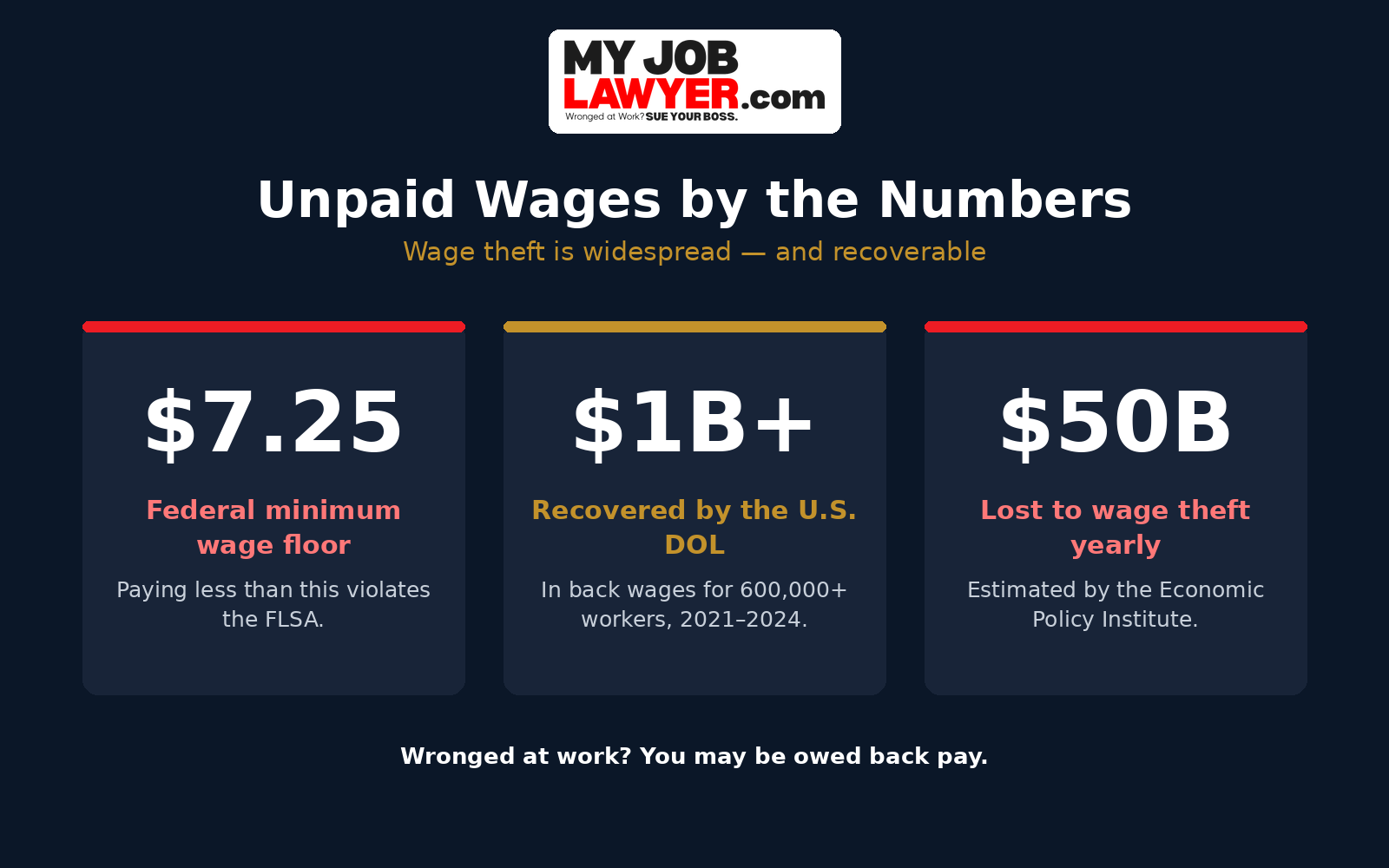
Under the federal Fair Labor Standards Act (FLSA), most employees must be paid at least the federal minimum wage of $7.25 an hour, and paying less than that breaks federal law. Many states, including California, New York, and Washington, set their own minimum wage, and if your state’s rate is higher, you’re entitled to that amount instead. The U.S. Department of Labor’s Wage and Hour Division (WHD) enforces both minimum wage and overtime standards. If your employer isn’t following them, you can turn to WHD for a remedy.
You’re also protected against unlawful deductions. Federal and most state wage laws bar employers from taking deductions that drop your pay below minimum wage or eat into your overtime. If your employer withholds wages or makes deductions that aren’t allowed, you can file a complaint with the appropriate labor agency.
If you’re a non-exempt employee under the FLSA working more than 40 hours in a week, you’re entitled to overtime pay at one and a half times your regular rate. Denying you that pay is a wage and hour violation in its own right. If you’ve already left the job, these same protections still apply. Your employer can’t withhold your final paycheck just because you quit or were let go.
Most states set strict deadlines for when that final payment is due. And if your employer has broken wage laws, you’re not just entitled to the wages you’re owed. Depending on your state, you may also be able to recover penalties, interest, or liquidated damages on top of the back pay. Before anything else, pull together your pay stubs, timesheets, and any messages about your pay. That paper trail makes your case stronger no matter the route you take next.
How Can I Sue My Employer for Not Paying Me?
If your employer failed to pay you the wages you earned, you have legal options to recover your pay and hold them accountable. Here’s how the process usually works.
Step 1. Gather Evidence of Unpaid Wages
Start by collecting proof. This includes pay stubs, timesheets, work schedules, emails, texts, bank statements, and your employment contract. These documents will help you build a strong case for wage and hour violations.
Step 2. Notify Your Employer or HR
Make sure you report the issue internally first. Sometimes unpaid wages come down to a simple error or miscommunication. Keep a record of every attempt you make to resolve it. If you decide to file a lawsuit later, this documentation can strengthen your case.
Step 3. File a Wage Claim With Your State Labor Agency
If your employer doesn’t fix the issue, file a wage claim with your state’s labor department or the U.S. Department of Labor’s Wage and Hour Division (WHD). These agencies investigate the claim, interview your employer, and review payment records. Often, they can recover your wages without you having to go to court.
Step 4. Consult an Employment Attorney
If significant back pay, retaliation, or discrimination is involved, talk to an employment lawyer. A good attorney can evaluate your claim, calculate what you’re owed, and figure out the best legal strategy for you. Most employment attorneys work on contingency, so you only pay if you win.
Step 5. Attempt Informal Negotiation or Mediation
Before filing a lawsuit, many attorneys begin by sending a demand letter requesting compensation. Some employers may choose to settle at this stage to avoid the time, cost, and stress of litigation. If negotiations or mediation do not lead to a fair resolution, you may then consider taking the matter to court.
Step 6. File a Lawsuit for Unpaid Wages
At this point, the process becomes official. Your attorney files a complaint detailing your claim, the wages and overtime owed, and any additional damages or penalties the law allows.
Wage claims usually come with deadlines. Under federal law, you typically have two years to file an FLSA claim, and three years if the violation was willful. State deadlines vary, and some are shorter. Waiting too long can mean losing your right to recover the wages you’re owed, so the sooner you start the process, the better your chances.
Wage Claim vs. Lawsuit
Not every claim requires a lawsuit. Sometimes a wage claim may be the better option. Here’s how filing a wage claim compares to taking your employer to court.
What Evidence Do I Need to Sue My Employer?
When filing a wage and hour lawsuit under the Fair Labor Standards Act, the strength of your evidence can make or break your case. The documentation that matters most includes pay stubs and wage statements. These are some of the strongest evidence you can bring, since they show your pay rate, recorded hours, and total payments. Comparing them against your actual hours worked often reveals the gap between what you earned and what the law says you should have been paid.
Timesheets and attendance records back that comparison up. Whether you kept them yourself or pulled them from your employer, they lay out exactly when you clocked in and out. Paired with your pay stubs, they make discrepancies hard to argue with. A timesheet showing 45 hours against a pay stub reflecting only 40 is hard evidence, not a guess.
Your employment contract matters too. It spells out your position, pay rate, schedule, and overtime terms, so it shows what your employer agreed to pay versus what actually entered in your account. If your employer violated these written terms, the contract or offer letter becomes key proof that they broke the law or their own policy.
Bank statements complete the paper trail, showing the amounts and dates you were actually paid. That financial record helps your attorney calculate what you’re owed, spot patterns of underpayment, and show the court your pay didn’t match your agreed rate or hours.
Any written complaints or requests for payment you sent to HR, payroll, or management are worth holding onto as well. They prove you tried to resolve things before taking legal action, which strengthens your case if it goes to court. If you don’t have every document, don’t assume you’re out of options. Employers are legally required to keep accurate time and pay records, and if they didn’t, that failure can work in your favor. Coworkers who witnessed the same pay practices can also back up your claim, even without paperwork.
What Are the Potential Outcomes of Suing My Employer?
Suing your employer for unpaid wages can go a few different ways. The U.S Department of Labor recovered more than $1 billion in back wages and damages for over 615,000 workers between 2021 and 2024 alone. The amount recovered usually boils down to your evidence, your legal strategy, and whether your employer chose to fight or settle.

The best outcome is usually full recovery. This covers every dollar of unpaid wages, overtime, or commissions you’re owed. Sometimes you get even more than that. Depending on your state and federal law, you might also recover liquidated damages, attorney’s fees, court costs, and interest.
Not every case ends this well, though. Sometimes you’ll land on a partial settlement instead. Maybe your employer disputes part of the claim, or both sides agree to settle outside of court. Either way, a good attorney still fights to keep penalties and legal fees on the table.
And sometimes, you walk away with nothing. Courts dismiss cases over thin evidence, missed deadlines, or job exemptions that rule out overtime pay. Strong pushback from your employer can sink a claim too. That’s why building your case early matters, and also why you shouldn’t wait until your state’s deadline is closing in.
Why Is Professional Legal Representation Important When Suing My Employer?
Suing your employer for unpaid wages can be complex, slow, and emotionally draining, especially if you don’t know employment law. It’s also intimidating. Your employer likely has a legal team backing them up, and facing that alone is stressful. However, hiring an employment attorney makes a real difference.
Employment law is full of nuance. Federal and state wage rules, overtime laws, and retaliation protections. An experienced attorney understands this and can pinpoint exactly what you’re owed, whether it’s unpaid wages, overtime, damages, or penalties. They can also spot violations you didn’t even know you had, like missed meal breaks or misclassification, which often hide alongside the wage issue.
A good attorney also helps you build your case the right way. They’ll gather pay stubs, contracts, timesheets, and any messages that support your claim, then know exactly how to present that evidence for the strongest impact. And if some of your records are missing, that’s not necessarily a dead end. Employers are legally required to keep accurate pay records, so gaps on your end don’t automatically sink your case.
Handling this alone also comes with real risk. Missed deadlines, miscalculated wages, or undocumented retaliation can all weaken a claim. An attorney walks you through the process step by step, so those mistakes don’t cost you money you’re rightfully owed.
Most wage disputes settle through negotiation, not trial, and that’s where a skilled attorney earns their place. They would push for a fair resolution without dragging you through court. They’ll also fight for more than just your back pay, including penalties, interest, and attorney’s fees. In many wage cases, the law requires your employer to cover your legal fees if you win, which means hiring a lawyer often costs you far less than trying to handle this on your own.
What Are the Next Steps If I Decide to Sue My Employer for Not Paying Me?
Understanding the steps to sue your employer for unpaid wages can simplify the process and increase your chances of recovering what you are owed. The first step is to gather and organize evidence, such as pay stubs, timesheets, employment contracts, emails, messages, or any other documentation that proves the hours you worked without being paid.
Next, consult a professional employment attorney who can review your documentation, assess the strength of your wage claim, and advise on the best strategy for recovering wages. Courts generally require that you attempt to resolve the dispute internally by sending a written demand to your employer or HR department before filing a lawsuit.
If the dispute remains unresolved, you can file a lawsuit against your employer. Depending on the amount owed, you may file in small claims court, state court, or, in certain cases, federal court. Once filed, the case will proceed through discovery and, if applicable, settlement negotiations.
If you win, you may be awarded your unpaid wages and any additional damages to which you’re entitled. It is crucial to have legal representation throughout these processes, as it helps navigate complex legal procedures and provides guidance, support, and peace of mind.
Ready to Sue for Unpaid Wages?
Has your employer failed to pay your wages, withheld your final paycheck, or engaged in wage and hour violations? You’re not alone. According to the Economic Policy Institute, theft costs workers an estimated $50 billion every year, and most of it goes unclaimed simply because people don’t take action. You don’t have to just accept it. Federal and state laws protect your right to every dollar you have earned, and taking legal action is often the most effective way to enforce that right.
That might mean filing a wage claim with your state labor department, the DOL, or pursuing a private lawsuit. The outcome depends on your situation, the strength of your evidence, how much you’re owed, and whether your employer is willing to make it right. Deadlines are real, evidence fades, and the longer you wait, the harder your case becomes to prove. You don’t have to figure this out alone, either. An experienced employment attorney can review your case, tell you exactly where you stand, and fight to recover what you’re owed.
At My Job Lawyer, our attorneys have spent 25+ years holding employers accountable and recovering what workers are rightfully owed. We’ve recovered $10 million-plus for workers across over 500 cases. If you are a victim of unpaid labour, contact us today for a free case review and take the first step toward getting your wages back.
Frequently Asked Questions
Suing your employer for unpaid wages comes with a lot of questions, especially if you’ve never dealt with a legal claim before. Below are answers to the most common questions we hear.
How Can I Sue My Employer for Not Paying Me?
Start by gathering proof, notifying your employer or HR, and filing a wage claim with your state labor department or the DOL. If that doesn’t resolve it, talk to an employment attorney and take your case to court.
What Are the Legal Steps to Take If My Employer Doesn’t Pay Me?
Speak with your employer first, gather evidence like pay stubs and contracts, and request payment in writing. If nothing changes, file a wage claim, consider a lawsuit, and keep in mind that retaliation for speaking up is illegal too.
What Are the Potential Costs Involved in Suing My Employer for Not Paying Me?
You’ll likely face monetary costs like attorney fees, court filing fees, and administrative costs. There are also non-monetary costs to weigh, like the time and emotional stress the process can take.
What Are Common Mistakes People Make When Suing Their Employer for Unpaid Wages, and How Can I Avoid Them?
The biggest mistakes are weak evidence, missed deadlines, skipping the internal complaint, and trying to handle it alone. Keep detailed records, act quickly, send a formal payment request, and loop in a wage attorney early.
Disclaimer: This article is for informational purposes only and should not be taken as legal advice. Employment laws vary by state and can change over time. Every wage dispute comes with its own facts and circumstances. Nothing in this article creates an attorney-client relationship between you and My Job Lawyer. If you believe your employer owes you unpaid wages, contact a licensed employment attorney to discuss the specific facts of your situation before taking legal action.