
There is no reliable national average settlement for a retaliation lawsuit. However, published estimates commonly place many workplace retaliation settlements between $5,000 and $100,000, while more serious cases can reach several hundred thousand dollars or more. Knowing this range in advance can help you set realistic expectations before filing your claim.
At My Job Lawyer, retaliation and wrongful termination cases are the core of our practice. Founder Steven P. Nassi brings over 25 years of experience fighting for employees wrongfully terminated due to retaliation. Under his guidance, our team has recovered over $10 million and won more than 500 employment law cases. If you’re a victim of retaliation, contact us today for a free case review and find out what your claim could be worth.
This article covers average retaliation settlement amounts, the factors that shape them, common causes of claims, and related employment law practice areas worth knowing about.
What Is the Average Settlement for Retaliation Lawsuits?
Retaliation settlements vary widely by state, industry, and the facts of your case. However, most published estimates are grouped based on severity. Low-severity cases, with little financial loss and relatively minor retaliation, usually settle between $5000 and $25,000.
Medium-severity cases, which typically involve larger lost wages, emotional distress, and evidence of retaliation, tend to fall between $25,000 and $100,000. While high severity cases that involve wrongful termination with significant financial harm and strong evidence often reach $100,000 to $250,000 or more. In rare cases involving serious misconduct, punitive damages may increase the value of your settlement beyond $250,000.
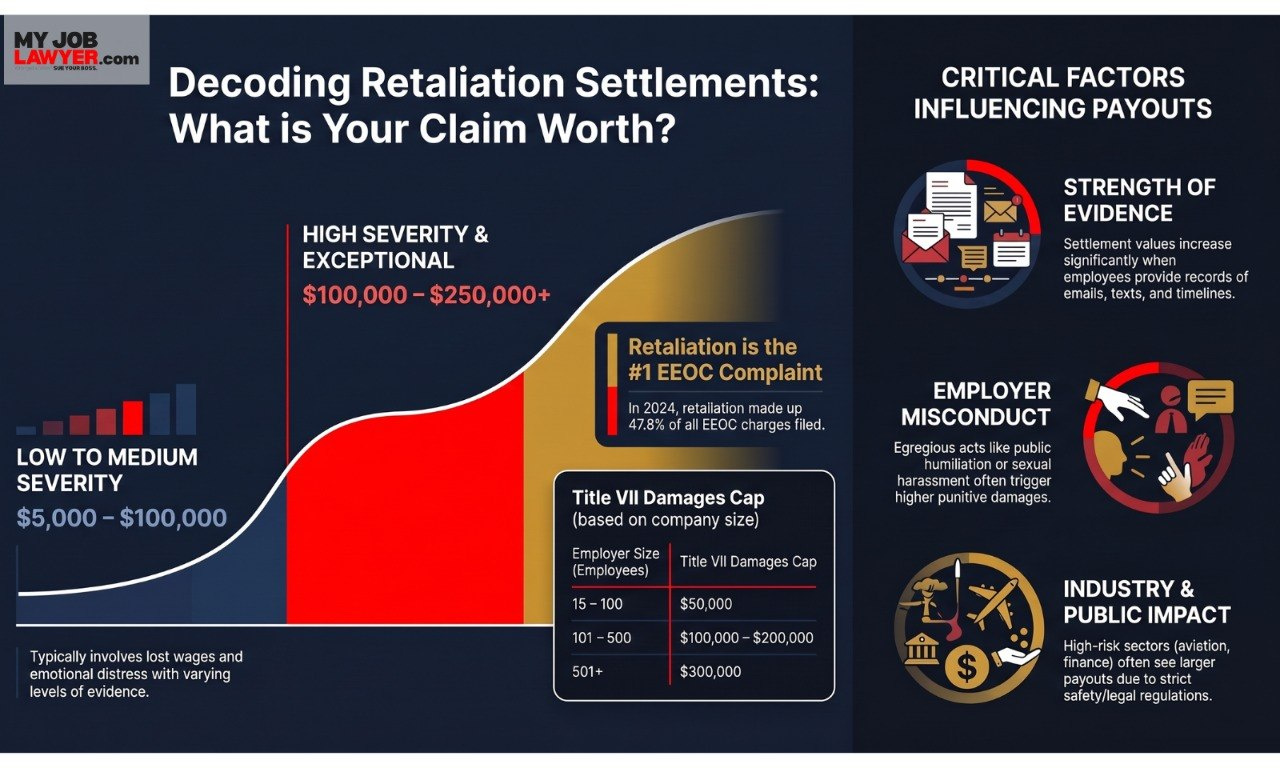
These are general published estimates, not guaranteed outcomes. Retaliation settlements vary significantly by jurisdiction, applicable law, damages, evidence, and case-specific circumstances.
While there is no universal average for retaliation lawsuit compensation, most settlements include lost wages and benefits, front pay, and emotional distress damages. They also cover other monetary compensation such as attorney fees and, when applicable, punitive damages. Workplace retaliation remains one of the most common types of employment law claims, and employers prefer to settle before trial to avoid public scrutiny, court costs, and further legal action.
What Are the Key Factors that Influence Settlements?

Retaliation lawsuit settlements vary based on several factors, and there’s no “one size fits all.” These factors decide whether your settlement will be in the tens of thousands, or if you could walk away with several hundred thousand dollars.
1. Severity of the Employer’s Retaliation:
When an employer punishes an employee through adverse actions such as wrongful termination, demotion, reduced hours, or creating a hostile work environment, it can significantly increase the settlement amount. These damages may include lost wages, lost benefits, emotional distress, and other economic damages.
2. Strength of the Evidence:
Settlement amounts usually increase when the employee has strong evidence showing that they engaged in a protected activity, the employer retaliated shortly afterward, and there is a connection between their complaint and the retaliation. To prove this, employees should keep records of emails, text messages, witness statements, and timelines. Strong evidence is crucial for proving retaliation in workplace retaliation cases and can significantly impact both compensatory and punitive damages awarded.
3. Employer Conduct:
If an employer engages in egregious misconduct, such as sexual harassment, public humiliation, or repeated retaliation, the case could qualify for punitive damages. Additionally, when an employer continually ignores retaliation or allows unlawful practices to continue unabated, it often faces larger settlement outcomes because of its inaction. Courts and juries also take an employer’s actions seriously, and a history of misconduct can influence settlement amounts, including back pay and front pay.
4. Employee Efforts to Reduce Damages:
Employees are expected to take steps to reduce the harm they’ve suffered, such as looking for another job or finding ways to manage the emotional stress they are facing. If they do not take these steps, their settlement may be lower. However, if they can prove they tried to recover and move forward with their lives, it can strengthen their overall claim.
5. Experienced Legal Representation and Negotiation:
Having strong legal representation can substantially influence the value of a retaliation case. An experienced attorney knows how to gather the needed evidence to prove retaliation, negotiate effectively with employers, and build a compelling argument in court. As a result, clients represented by a law firm experienced in whistleblower retaliation cases and other discriminatory cases usually secure a more favorable settlement.
6. Jury Reactions and Public Attention:
Cases that attract media attention or raise public concerns, such as whistleblower retaliation involving fraud or safety violations, often result in larger compensation. When the court views the employer’s conduct as unethical or abusive, juries may be more inclined to award a reasonable settlement.
7. Employer’s History of Misconduct:
Another factor that can significantly affect settlement values is an employer’s past track record. If an employer has a history of mistreatment, retaliation complaints, ongoing labor law violations, or other discriminatory practices, it can strengthen the employee’s retaliation claim.
8. Legal Standards and Damage Caps:
Additionally, the laws that apply to a retaliation claim can limit or expand what’s recoverable. Under Title VII of the Civil Rights Act of 1964, compensatory and punitive damages are capped based on the size of the employer, which limits recovery even in cases with strong facts.
Other laws, such as California’s Fair Employment and Housing Act (FEHA), do not impose caps on damages, which often leads to higher settlements and verdicts than those available under the law.
How Is the Average Settlement Determined?

One way to determine the average settlement in a retaliation lawsuit is to evaluate the employee’s financial losses, emotional harm, and the strength of the evidence. Attorneys usually weigh the retaliation’s impact on the employee’s income, career opportunities, and overall well-being. They also examine whether the employee engaged in a legally protected activity and whether the retaliation resulted from it.
In addition, attorneys compare similar cases to see how courts have ruled and what employers have paid in the past. However, every retaliation claim is different, and there is no standard average settlement amount. As a result, the final settlement amount depends on the employee’s evidence, legal representation, and negotiation strength.
What Are the Common Reasons for Retaliation Lawsuits?
Retaliation occurs when an employee faces adverse consequences for reporting unlawful or unfair workplace behavior. When this happens, the employee has the right to file a lawsuit against their employer.
Common triggers include reporting discrimination or harassment based on race, sex, age, disability, or other protected characteristics, and participating in an investigation by giving statements or cooperating with an internal review. It can also include challenging unlawful workplace practices, even just hinting that you might file a complaint.
Retaliation often follows other protected actions too, like requesting reasonable accommodations under the Medical Leave Act for a disability or religious practice, or discussing pay with coworkers to uncover unfair wage-and-hour practices. When an employer takes adverse action against an employee for engaging in any of these protected activities, it can lead to serious legal consequences and larger settlement amounts.
Can Industry Affect Settlement Amounts?
Yes, the industry an employee belongs to can influence the value of a retaliation case settlement. Some industries operate by very strict rules and high safety requirements. If the company or industry has a significant impact on the public, this could increase the settlement amounts.
For example, sectors such as construction, aviation, or chemical manufacturing typically face a high level of risk, and accidents in these fields can cause serious harm. In cases like this, the payout is often larger because of the dangers involved. Additionally, industry regulations can affect the total compensation figure, as companies with strict safety or legal standards may face higher settlement amounts when those rules are broken.
The type of damage involved also plays a critical role. Physically demanding industries often face settlements focused more on medical bills, personal injury, and lost wages. On the other hand, industries like finance are more likely to face losses tied to fraud or financial harm.
A company’s resources can also affect negotiations, since larger and more profitable businesses are usually expected to pay more. Finally, a company’s public image or reputation could lead it to settle quickly to avoid bad publicity.
A Real Case Example
Numbers on a page only tell half the story, so it helps to see how a real case plays out. In October 2025, the Indiana Court of Appeals affirmed a jury verdict in favor of Jarissa Gillaspy, a personal trainer who alleged she was retaliated against after reporting sexual harassment by her gym’s owner. After she filed a discrimination charge with the Indiana Civil Rights Commission and the EEOC, her employer introduced new sales requirements she couldn’t meet given her job duties, then terminated her. The jury awarded her $2.5 million.
It’s worth noting that a jury verdict isn’t the same thing as a settlement; verdicts can run higher since they reflect what a jury decided the harm was worth after a full trial, while settlements reflect what both sides agreed to avoid that risk. Still, cases like this show why employers take retaliation exposure seriously long before a case ever reaches a jury.
Are There Recent Trends in Retaliation Settlements?
Retaliation claims are among the most common settlement cases. For several years, they have remained the most frequently filed charge with the Equal Employment Opportunity Commission (EEOC). In fiscal year 2024, employees reported 42,301 retaliation claims, making up nearly 47.8% of all EEOC complaints.
The EEOC’s enforcement activity has continued to climb since then. In its fiscal year 2025 report, the agency secured roughly $660 million for more than 17,680 victims of workplace discrimination, including a record $528 million recovered through pre-litigation resolutions like mediation and conciliation. That figure doesn’t even capture the full picture, because it excludes private settlements and court awards obtained outside the EEOC’s own process. This means the real total recovered by retaliation victims each year is considerably higher.
Another major event took place in April 2024 when the Supreme Court decided Muldrow v. City of St. Louis. Before this decision, employees had to prove they suffered a serious or major disadvantage to qualify for a Title VII discrimination claim. Now, employees only need to show they suffered some form of harm, even if it’s minor.
Although the case bordered on discrimination, this new standard will likely affect retaliation cases as well. This means that it might be more difficult for employers to get these kinds of cases dismissed since employees no longer need to prove a significant or extreme harm, just some harm.
Ready to Find Out What Your Claim Could Be Worth?
Getting demoted, fired, or excluded from opportunities just because you spoke out can be discouraging and overwhelming. In recent years, employees have recovered hundreds of millions of dollars through EEOC resolutions, with a large portion of those being retaliation-related claims.
This means you’re not alone and you’re not without options. If you’ve experienced or are still experiencing retaliation, you do not have to stay quiet. With the assistance of an experienced employment lawyer, you can better understand your legal rights, strengthen your claim, and pursue the justice and financial relief you deserve.
At My Job Lawyer, our team of experienced employment attorneys helps retaliation victims across industries obtain the compensation they deserve. Are you tired of being treated unfairly? Our team of experienced employment attorneys specializes in retaliation cases, including whistleblower retaliation, sexual harassment, and wage violations. Contact us to book a free case review or learn more about our services.
Frequently Asked Questions
Pursuing settlement for retaliation can raise a lot of concerns. Below are common questions people ask about retaliation lawsuit settlements, along with straightforward answers to help you know what to expect.
How Is the Average Settlement for a Retaliation Lawsuit Determined?
The average settlement is determined based on past cases, the strength of the evidence, the extent of the damage, and the potential costs for both sides if the case goes to court. Lawyers also consider industry trends, the employer’s size, and how judges or juries have ruled in similar cases.
What Are Common Reasons for Retaliation Lawsuits and Their Settlements?
Retaliation lawsuits occur when an employee is punished for speaking up about something protected by law. This could range from reporting discrimination, harassment, unsafe conditions, wage issues, or illegal practices. Settlements happen because employers want to avoid high legal costs, bad publicity, or the risk of losing at trial.
How Is the Average Settlement Amount for a Retaliation Lawsuit Calculated?
The average settlement amount is usually based on the employee’s financial losses, emotional distress, career damage, and the strength of their evidence. Lawyers could also include the potential penalties the employer could face and the likelihood of winning in court.
What Role Does Legal Representation Play in Negotiating a Settlement for a Retaliation Case?
A lawyer helps the employee understand their rights and gather sufficient evidence. They also help negotiate with the employer to get the most favorable outcome. Working with experienced attorneys often increases your chances of securing higher settlements.
How Do Employment Attorneys Help in Retaliation Cases?
Employment attorneys provide legal guidance, help prove retaliation, negotiate fair settlements, assist with filing formal discrimination complaints or right-to-sue letters, and ensure compliance with federal law, the Civil Rights Act, and employment laws.
What Is the Process for Filing a Retaliation Claim, and Are There Deadlines or Fees I Should Be Aware of?
Most retaliation claims must be filed with the Equal Employment Opportunity Commission (EEOC) or a similar state agency before the filing deadline. This is usually within 180 to 300 days of the retaliatory action, depending on your location. Other claim types run on their own clocks; harassment, for instance, has a separate filing deadline for sexual harassment claims.
Disclaimer: Attorney Advertising. This blog is for informational purposes only and does not constitute legal advice. Every retaliation case is different, and the retaliation settlement value depends on the specific facts, evidence, and jurisdiction involved. Reading this article does not create an attorney-client relationship with My Job Lawyer. For guidance on your specific situation, please consult a licensed employment attorney.