
Under normal circumstances, your boss can’t terminate your employment because you’ve used your accrued paid time off for illness, because of protected medical leave, or because you have a disability that can be accommodated. Because California is an at-will employment state, a sick worker can still be let go for a lawful, unrelated reason. Getting fired when you’re sick can be legal, but firing someone because they took protected time off or because they have a protected health condition is not acceptable
At My Job Lawyer, we have recovered more than $10 million for workers across 500+ cases in over 25 years (past results do not guarantee a similar outcome). Our wrongful termination lawyers investigate whether an employer has penalized an employee who has used sick leave or medical time off. We also gather evidence to support a claim. If you lost your job after you had to call in sick, schedule a free consultation with our team.
This article explains how sick leave in California and related laws protect your job, when a firing turns illegal, and what to do next.
Key Takeaways
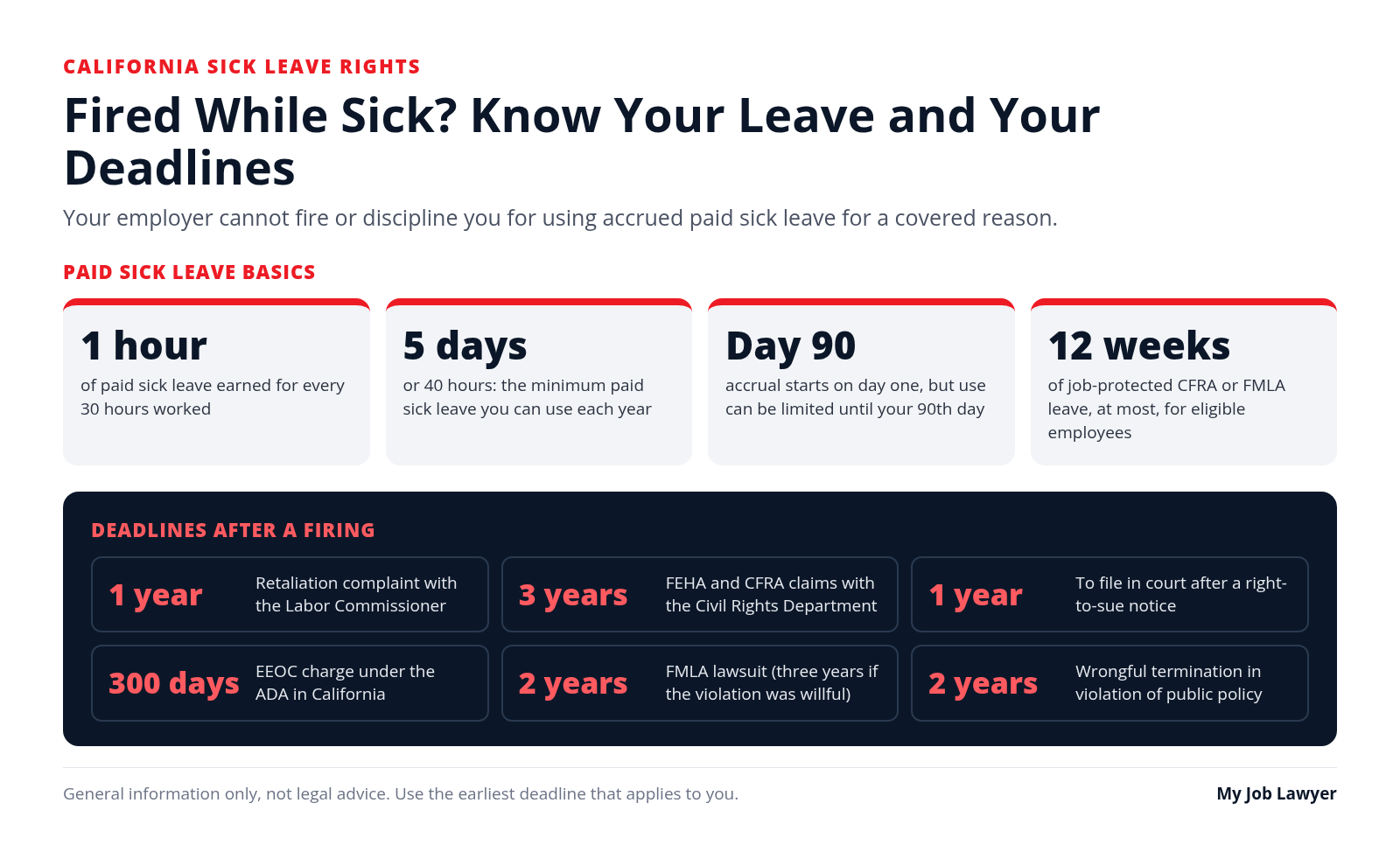
California employers cannot fire or discipline you for using accrued paid sick leave for a covered reason. Most workers earn at least one hour of sick leave for every 30 hours worked and can use at least five days a year. CFRA and the FMLA give eligible employees up to 12 weeks of job-protected leave for a serious health condition. A termination may still be lawful if you exhaust your protected leave, do not meet the qualifications for it, or are unable to perform your job even with reasonable accommodations. Complaints regarding retaliation for taking sick leave typically must be filed with the Labor Commissioner within one year.
How Does Sick Leave Work Under California Law?

California’s paid sick leave law comes from the Healthy Workplaces, Healthy Families Act of 2014. Since January 1, 2024, employers must generally provide at least five days or 40 hours of paid sick leave a year. The law covers most employees who work at least 30 days for the same employer within a year, including part-time and temporary employees.
Under an accrual policy, you earn at least one hour of paid sick leave for every 30 hours that you work. Accrual starts on day one, but your employer may limit use until your 90th day on the job. Some employers in California give a full year’s worth of paid sick leave upfront all at once. Employers can cap the total you hold at 80 hours or 10 days, and unused accrued sick time carries over.
You can use paid sick days for your illness, preventive care, or treatment of an existing health condition. You can also care for an ill family member, meaning a parent, child, spouse, registered domestic partner, grandparent, grandchild, sibling, or designated person. There is no severity test, so you don’t need a serious medical condition to qualify. Since 2025, the leave also covers jury duty and testifying under a subpoena. Survivors of domestic violence, stalking, and other qualifying violence can use it to seek a restraining order. Survivors at companies with 25 or more employees can also utilize this leave for medical care, counseling, and safety planning.
You can request leave orally or in writing, and your employer can’t make you find a replacement first. Your paycheck stubs or separate written notice must show your available balance. Vacation time is different; unused sick days don’t get paid back at all when someone leaves their job. If you get hired back by the same employer within 12 months, then you’ll be brought back on board again.
Paid leave for illnesses is still not universal across the country. In March 2026, the U.S. Bureau of Labor Statistics found that 81% of workers in private industry had paid time off for sickness. For private workers in the bottom quartile, this number fell to 61 percent. California’s state law sets a floor that doesn’t depend on an employer’s generosity.
How Do the ADA and FEHA Apply in California?
The Americans with Disabilities Act is a federal law covering employers with 15 or more employees. California’s Fair Employment and Housing Act (FEHA) goes further and applies to employers who have at least five or more employees. The two laws define disability differently as well.
Under the ADA, a condition must substantially limit one or more major life activities, such as breathing or working. FEHA only requires that a condition limit a major life activity, so chronic illnesses like diabetes or lupus often qualify. FEHA separately protects a “medical condition” that deals with cancer and genetic traits.
If you tell your boss that you need assistance due to a health issue, FEHA requires that both parties engage in good-faith interaction. The employer may ask for medical documentation and must then work with you to find reasonable accommodations. Common options include a modified schedule, short-term leave, remote work, or adjusted job duties. An employer can refuse to provide reasonable accommodation only if doing so would cause them significant hardship. Skipping out on that interactive process also constitutes a violation, and California law protects workers who request an accommodation against retaliation.
A lot of workplace complaints are about disability claims. The U.S. Equal Employment Opportunity Commission received 36,256 disability charges in fiscal year 2025, or 41.1% of all charges. Federal statistics exclude complaints filed only with state agencies. According to reports from the California Civil Rights Department in 2024, disability is cited as the most common reason for employment complaints; this reason appears in 2,174 out of 4,077 cases that were reviewed. If a manager turns hostile after someone diagnoses them of something serious, that may be called disability discrimination at work.
When Can You Be Fired for Being Sick in California?

Can you get fired if you get sick in California? In some situations, yes. Employment at will means that employers can terminate your job for any lawful reason as long as they’re not breaking the law. Illness won’t shield you from a genuine layoff, misconduct, or a performance problem that started before you got sick.
You Exceed Protected Leave Time
The California Family Rights Act (CFRA) works in conjunction with the federal Family and Medical Leave Act, and employees who qualify can get up to 12 days of unpaid leave per year according to law. That time can go toward your own serious health condition, a relative’s, or bonding with a new child. The 26-week figure you may see online applies only to FMLA military caregiver leave.
Once you use up the 12 weeks, neither law requires your employer to hold your position. That’s not always how things end. If your condition is a disability under FEHA, extra time off can be a reasonable accommodation, so ask for it in writing before your leave runs out. Pregnancy Disability Leave is separate and allows up to four months without using your CFRA time.
You Do Not Qualify for Protected Leave
CFRA applies to companies that have at least five or more employees. After serving more than 12 months of service and having worked at least 1,250 hours in the last year, you qualify now. The FMLA has similar rules, but they apply only if the company has at least 50 employees within 75 miles of each other.
A recent hire at a small business may not qualify for either law. In that case, a long absence for illness can lead to a lawful firing. Paid sick leave and FEHA can still protect you too.
Your Condition Prevents You From Doing the Job Even With Accommodation
The FEHA and ADA both safeguard workers who can do essential job duties either with or without any kind of accommodation. If there is no possibility of accommodation, the employer may legally terminate your employment. An open-ended leave with no expected return date can fall into this category.
Before reaching that point, the employer must work through the interactive process and consider options like a transfer to an open position. Going straight to termination without having that talk increases real legal risk for the employer.
When Is Firing an Employee Because of Illness Illegal?
A firing becomes illegal when its real reason is one the law protects. The clearest example is accrued sick leave. Labor Code section 246.5 prohibits employers from refusing to allow accrued sick leave or penalizing people for requesting or using this leave. That protected sick leave covers a single morning at the clinic as much as three days in bed.
Firing someone because they request or take leave under CFRA or FMLA is illegal too. It also includes protected time off work to take care of a sick family member. Serious health conditions usually mean hospitalization or continuing treatment such as chemotherapy or a heart condition.
Firing someone because they have a disability or ask for an accommodation is against FEHA rules. The signs of discrimination tend to be very subtle. A manager may suddenly issue a performance improvement plan right after you let them know about your health condition.
Retaliation rules go further. If you report behavior that you reasonably believe is illegal, Labor Code section 1102.5 and related whistleblower protections may be involved. If your illness came from the job, you may still collect workers’ comp after a termination. Any of these reasons can make an absence legally protected.
Can Your Employer Count Sick Days Against You?
Many companies run attendance point systems that discipline workers after a set number of absences. California Labor Code limits how sick leave is treated under policies. Under Section 233 the kin care benefits, you can use the sick leave that you would accrue in six months for any covered reason. Section 234 says that any policy allowing protected leave as a form of discipline is inherently illegitimate.
The Labor Commissioner’s guidance is direct. If you use accrued sick days for a covered reason, your employer can’t give you an “occurrence” for that protected absence. Once your balance runs out, though, an unscheduled absence can count under a lawful policy, unless CFRA, the FMLA, or FEHA covers it.
That gap is where many disputes start. A supervisor may count every sick day the same way without checking how many you have left. If you were fired for too many sick days while paid time was still banked, that can support a retaliation claim. Check the company’s policy on sick leave and compare that with your paycheck stubs. Some people who work in this position bring a retaliation lawsuit against the employer.
How California Sick Leave, CFRA, FMLA, and FEHA Protections Compare
There are overlapping laws here, and many workers in California are covered by more than one at the same time. The table compares each protection directly side by side so you can see what rules may apply to you.
What Should You Do if You’re Fired While Sick?
The first days after a firing shape the whole case, because records disappear and deadlines start running. Following these steps in sequence leaves all options open for you. Don’t sign a severance agreement or release until an attorney has read it.
Review Your Employment Contract and Company Policies
First, write down the date of the firing along with who was present and what was said. Then gather your offer letter along with any written contracts and handbook sections that address sick leave, attendance policies, and disciplinary actions. A contract that allows termination only for good cause would support a breach of contract claim. Make sure to save copies of things that you should keep before losing access to company systems.
Request Your Termination Notice and Personnel File
Lastly, please ensure that you have written notice of termination. Under Unemployment Insurance Code section 1089, employers must give that notice right away, though it doesn’t have to state a reason. Labor Code section 1198.5 lets you request your personnel file, and the employer must provide copies within 30 days of your request. Employers rarely write “you were sick” on a termination notice, so compare the stated reason with your records.
Gather Medical Documentation
Then collect the medical side of the record. Keep all your doctor notes, summaries of visits, restriction work forms, and any leave certifications that you have filed. Create a simple timeline that shows when you got sick, when you told your boss about it, and when the firing happened. Emails and messages from managers about your absences tend to carry serious weight.
Contact Human Resources or Your Union
After that, consider raising the issue with human resources in writing. Sending an email using accrued sick time leaves a dated record of what was known at the company. If you belong to a union, your representative can file a grievance, which may have its own short deadline. Keep the tone factual, since an agency or judge may read it later.
Contact an Employment Attorney
Talk to an employment lawyer before filing anything. An employment lawyer can help sort through which laws apply, which agency handles things, and which deadline comes first. Knowing when you need a lawyer early can safeguard claims that you weren’t even aware of having. At our firm, the employment law process starts with a review of documents during free consultations.
File a Wrongful Termination or Discrimination Claim
Finally, file with the right agency or court. Sick leave retaliation complaints go to the Labor Commissioner’s Office, while FEHA and CFRA claims start with a Civil Rights Department intake form. Before you can sue your employer under FEHA, you need a right-to-sue notice, which you can request right away. ADA claims require an EEOC charge first, while FMLA claims can go to the Department of Labor or straight to court. People often ask how long a case takes, and that depends on whether it settles early.
Is There a Deadline to File a Wrongful Termination Claim?
The deadline for filing a complaint depends on the applicable law. Specifically, a retaliation complaint with the Labor Commissioner must be submitted within one year of the retaliatory act occurring. For FEHA and CFRA claims, you have 3 years from the date you were last harmed to file with the Civil Rights Department. After you receive a right-to-sue notice, you generally have one year to file in court.
Federal claims run on different clocks. In California, an EEOC charge under the ADA is due within 300 days. FMLA lawsuits generally must be filed within two years, or three years for a willful violation. A claim for wrongful termination in violation of public policy usually has a 2-year time limit. Claims that breach a contract go up for two years if it was an oral agreement and for four years if it’s a written one.
Here’s how that plays out. If you get fired on March 2, 2026, you generally have until March 2, 2027, to file a Labor Commissioner complaint. The intake from the Civil Rights Department is due on March 2, 2029. Use the earliest deadline as your actual deadline because the statute of limitations runs while you wait for HR approval.
What Compensation Can You Get if Wrongfully Fired for Being Sick?

The remedy depends on what law was violated and how much that firing hurt you. Losing income is usually the first harm, but rarely the only one. A lawyer can explain what you can sue for, and FEHA allows prevailing employees to recover reasonable attorney fees.
Lost Wages
Lost wages mean your pay for salary, bonuses, and benefits that you missed out on from being fired until a settlement or judgment is reached. If returning isn’t realistic, a court may also award front pay for future earnings. Since getting income from a new job is causing stress for back pay and front pay, be sure to keep track of your job hunt.
Emotional Distress Damages
Getting fired when you’re sick tends to make managing that illness harder. FEHA claims can include compensation for anxiety, humiliation, lost sleep, and similar harm. Suing for emotional distress relies heavily on medical records and testimonies because there is no fixed formula for determining amounts.
Reinstatement
Reinstatement gets you back in your former job or a comparable one. A labor commissioner can be ordered for retaliation cases as sick leave, and courts can also order such leave under FEHA, CFRA, and FMLA. Restoring job security is good, but many workers prefer not to return to an employer that forced them out. In that case, front pay usually takes its place.
Punitive Damages
Punitive damages mete out punishment to employers for particularly egregious behavior rather than compensating you for losses you’ve suffered. Under Civil Code section 3294, you must prove malice, oppression, or fraud by clear and convincing evidence. Generally speaking, for a company, an officer, director, or managing agent needs to be involved. Some discrimination settlements reach seven figures partly because of punitive exposure, though these damages aren’t available in every case.
Ready to Protect Your Job After Being Fired While Sick?
California offers real protection to workers who are sick via paid time off, family care leave rights, and reasonable accommodations under FEHA as well. A firing that looks legal on paper can still be retaliation when the timing or attendance records tell a different story. If you were let go after using sick time, reaching out soon helps preserve evidence and meet the earliest deadline.
Our team has recovered more than $10 million for workers across more than 500 cases over 25 years, though past results do not guarantee a similar outcome. Steven Nassi, named a Super Lawyers Rising Star for New York Metro from 2014 to 2018, works with our employment lawyers in California on these claims. Contact us today to schedule a free consultation.
Frequently Asked Questions
Our attorneys hear these questions often from California employees, usually within days of a termination. The responses here comply with current guidance from the Labor Commissioner and the Civil Rights Department.
Can an Employer Ask for a Doctor’s Note Every Time I’m Sick?
Generally, no, at least for paid sick leave. The Labor Commissioner says an employer may not deny paid sick leave only because you lack a doctor’s note. CFRA and FMLA leave are distinct from each other, and employers can request medical proof for both.
What If My Employer Refuses to Give Me Sick Leave?
Refusing accrued sick leave you’re entitled to use violates the paid sick leave law. You can file a claim with the labor commissioner, and your boss can’t discipline you for that action.
How Much Sick Leave Am I entitled to in California?
Most employees get at least one hour of paid time off for every 30 hours they work and can use at least 40 hours or five days of paid leave each year. Employers may cap accrued leave at 80 hours or 10 days, or offer more.
Is My Boss Allowed to Fire Me for Being Sick?
Your boss can’t fire you for using protected sick leave, taking CFRA or FMLA leave, or having a disability that can be accommodated. It’s still legally okay to fire someone even if there’s another legitimate reason like documented layoffs.
What Is the Kin Care Law in California?
Labor Code section 233 lets you use the sick leave you’d accrue in six months for covered purposes, including caring for a sick family member. Section 234 bars attendance policies that discipline you for that leave.
Can My Employer Fire Me for Taking Too Many Sick Days?
If you use paid sick leave that is both accrued and available for a covered reason, then it won’t happen. If you run out of balance points, then unplanned absences count unless they are protected under CFRA, FMLA, or FEHA.
What Proof Do You Need to Support a Sick Leave Termination Claim?
Useful proof includes medical records, pay stubs showing your sick leave balance, the termination notice, and messages about your absences. A timeline linking your leave to the firing is often the strongest piece.
Can You Get Unemployment Benefits After Being Fired While Sick?
Yes, generally speaking, if you haven’t been laid off for misconduct and you’re ready and able to work. If you’re too sick to work, State Disability Insurance through the EDD may replace part of your wages.
Related reading
- FMLA lawyer for medical leave rights
- Help after a wrongful firing
- Collecting workers’ comp after being fired
Disclaimer: This article is for informational purposes only and does not serve as legal advice. Reading My Job Lawyer or contacting them does not establish an attorney-client relationship. Past results do not guarantee a similar outcome.